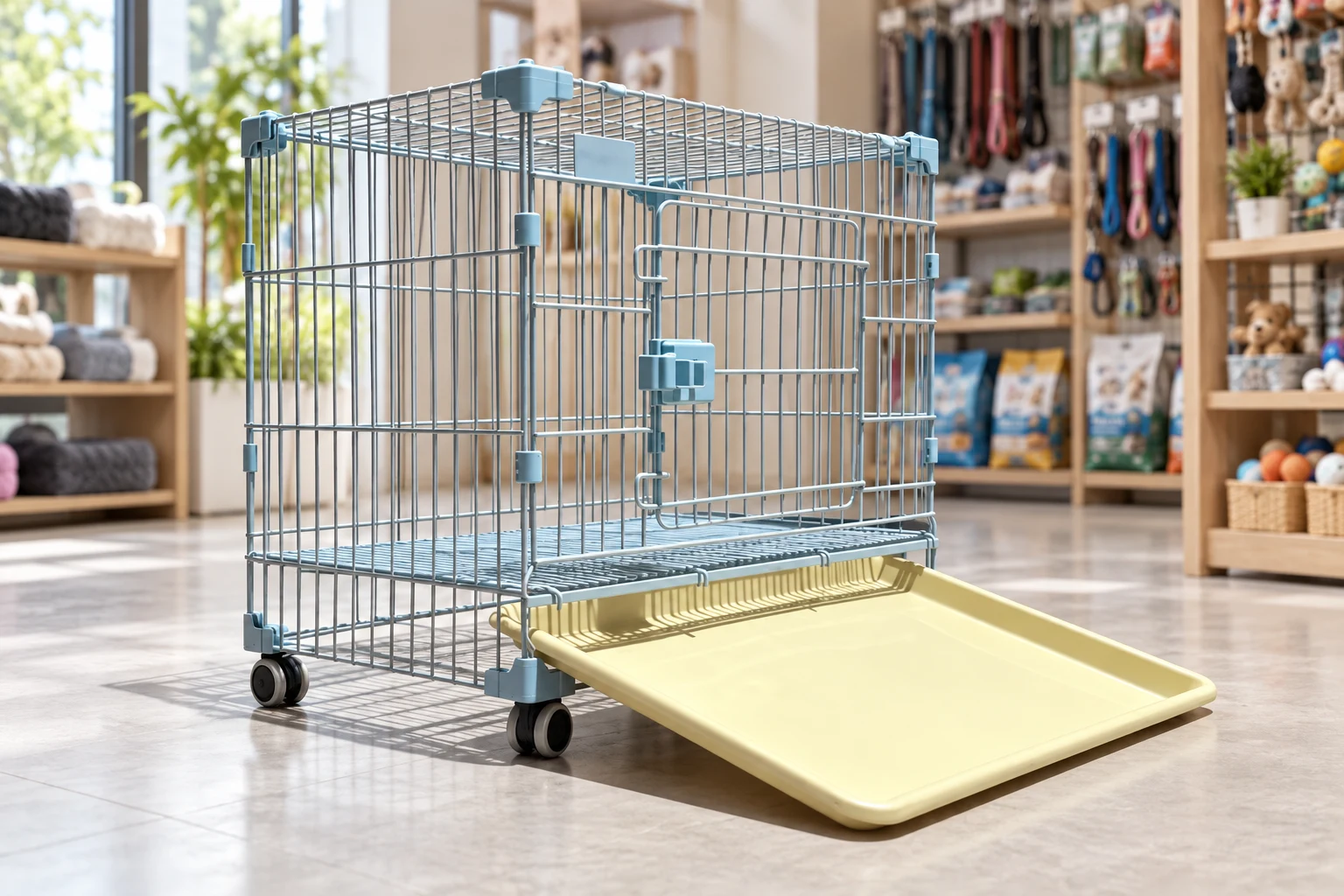
A pet cage on a store floor needs to do more than look good in a catalog. Staff should be able to show how the door opens, where the tray sits, and what customers need to measure before buying. The 80 cm swing-door metal pet cage gives retailers a concrete product around which to build that demonstration: a wire enclosure with blue connectors, a front swing door, caster wheels, and a removable tray.
This spotlight examines the 80 cm swing-door metal pet cage as a retail assortment candidate. It separates factory-listed measurements from features visible in the product photograph, and highlights the questions to settle before placing a wholesale order.
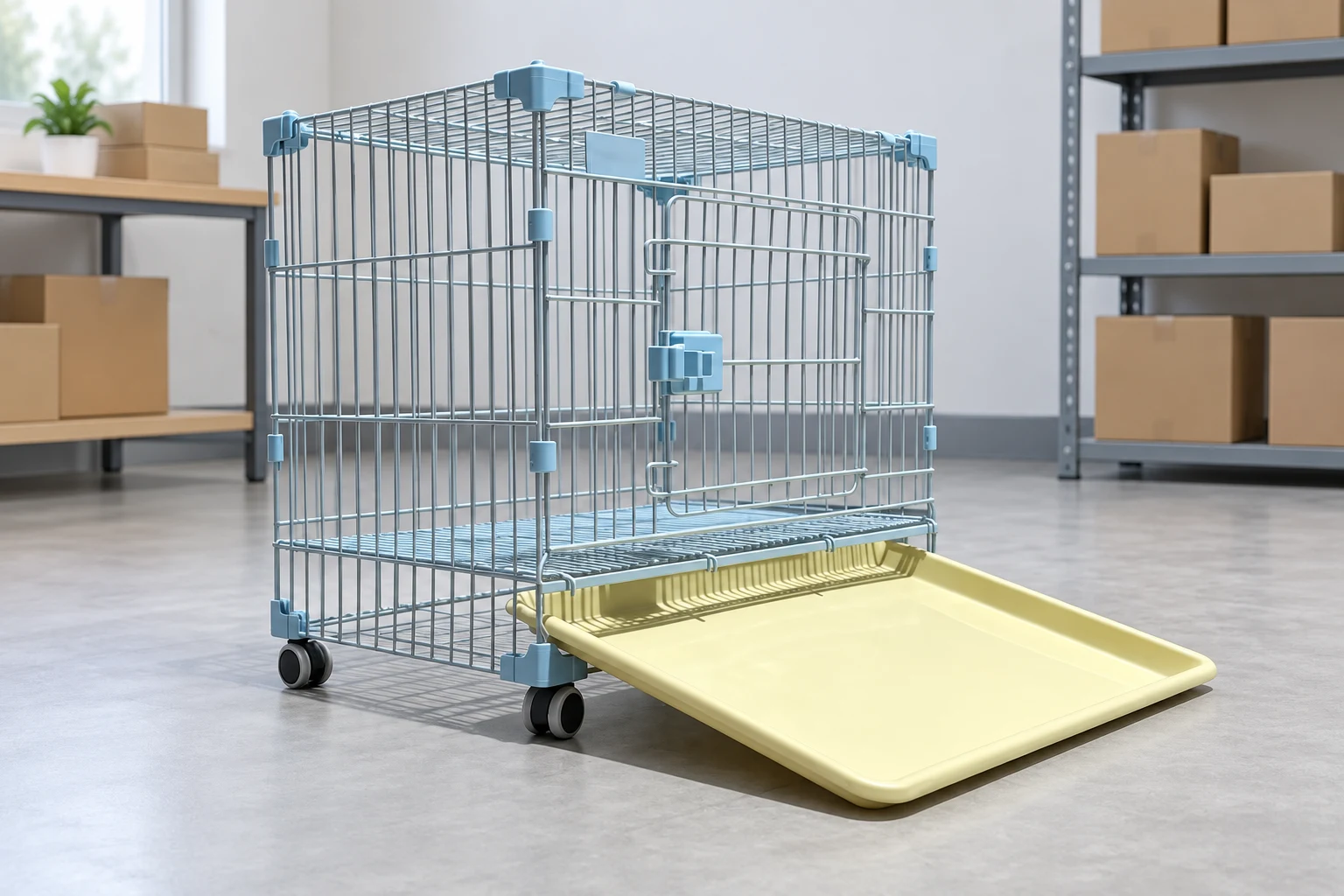
The cover and back-room scene below are AI-generated presentation images based on the supplied product photograph. They illustrate possible display environments, not actual customer installations. Refer to the original photograph and an approved sample for exact product details.
The product at a glance
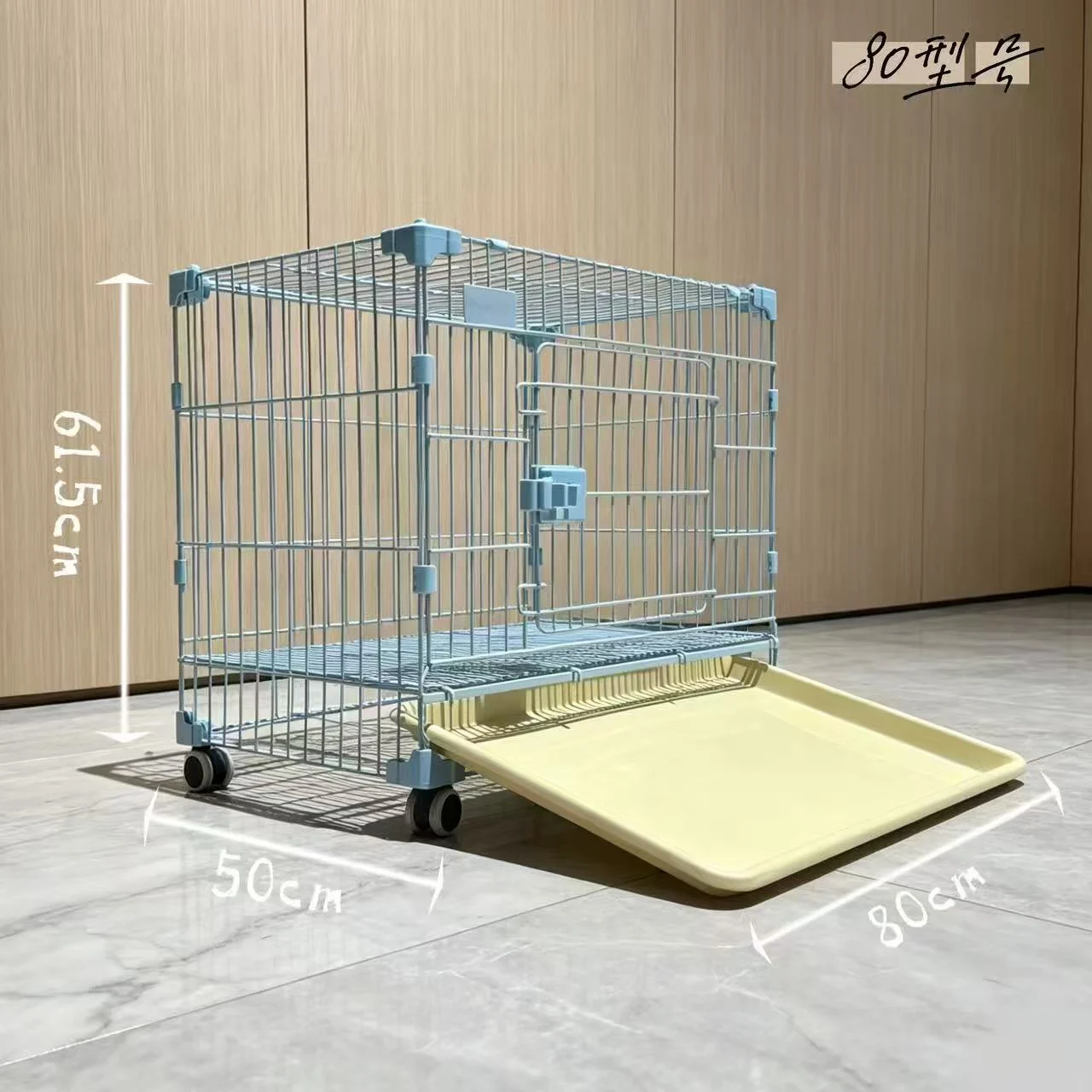
- Factory-listed overall dimensions: 80 cm length × 50 cm width × 61.5 cm height.
- Listed net weight: 10.3 kg.
- Listed gross weight: 11.2 kg, with one unit per carton.
- Visible configuration: metal wire enclosure, front swing door, blue plastic connectors and latch, caster wheels, raised wire floor, and a pale yellow removable tray.
The source sheet presents dimensions in length × height × width order; the figures above have been rearranged into length × width × height for easier reading. These are overall measurements, not a verified usable interior size or door-opening measurement. Confirm the current sample and packing specification before calculating shelf space, shipment volume, or customer fit.
Why it deserves a hands-on demonstration
For a buyer planning a physical store assortment, this model offers several separate points that staff can explain without relying on broad claims such as “heavy duty” or “escape proof.” Its open wire construction makes the interior visible. The front door gives a clear access point. The tray and wheels are identifiable components that can be shown individually.
Those features are useful presentation topics, but they are not performance certifications. The available source does not establish a pet-weight rating, wire spacing, coating specification, wheel load rating, or latch test result. A responsible display makes the visible configuration easy to understand while leaving unverified claims off the shelf card.
Build a three-step store-floor demonstration
1. Show access with the cage empty
Place the sample on a level surface with enough room in front for the swing door to open freely. Let staff demonstrate opening, closing, and checking the latch. Inspect the sample for sharp edges, distorted wire, or a door that catches. Customers should see how the actual unit works rather than infer operation from a staged photograph.
Leave the door's movement area clear of aisle traffic and nearby merchandise. For a broader merchandising plan, our pet-store dog cage supply page explains the retail sourcing context. This particular display should remain focused on one model, one specification card, and a short, repeatable demonstration.
2. Explain the tray without promising maintenance-free care
The source image shows the pale yellow tray withdrawn from beneath the raised floor. Use an empty cage to demonstrate removal and reinsertion, then return the tray to its operating position. Explain that a removable tray does not eliminate cleaning of the floor, corners, bars, or door.
Ask for the confirmed tray material and suitable cleaning instructions before recommending detergents. The product photograph alone cannot establish chemical resistance, dishwasher suitability, or a disinfection procedure. Do not display an animal in the cage with the tray pulled out simply to reproduce the product image.
3. Demonstrate positioning, not transport
The photograph shows caster wheels, making mobility a sensible topic to investigate with the sample. Check how the empty unit moves on the intended store flooring and ask whether the supplied wheel configuration includes brakes. Do not assume that visible wheels make the cage suitable for moving an animal, vehicle restraint, or airline transport.
A specification card that helps customers ask better questions
A useful card might read: “80 cm swing-door metal pet cage; listed overall size 80 × 50 × 61.5 cm (L × W × H); removable tray; caster wheels; ask staff to check usable space and suitability.” Avoid assigning a dog breed or maximum body weight from the model name alone.
Measure the individual animal and verify the usable interior and access opening on the sample. The animal must have appropriate room to stand, turn, and rest naturally; floor comfort and any risk from wire spacing also require assessment. Our wholesale cage size guide provides the wider measurement checklist. An 80 cm external length is not, by itself, a promise of suitability for a particular dog.
Turn the display sample into a clear wholesale brief
Record the approved door operation, tray fit, connector color, wheel configuration, and finished appearance. Keep sample photographs with the order specification so the sales team, purchasing team, and factory are referring to the same version. Check carton markings and included parts on a packed sample rather than estimating them from the assembled photograph.
Standard products can be discussed from 100 pieces; availability and the final order arrangement need confirmation. If your retail brand needs different colors, labeling, packaging, or a revised specification, use our OEM and ODM development service to define the request. Custom work requires its own feasibility, sample, quantity, price, and lead-time discussion; the standard-product quantity should not be treated as a custom-project commitment.
Is this the right model for your assortment?
Consider this cage when you want a metal wire model that store staff can present through a practical door-and-tray demonstration. Compare it with your available display footprint and customer requirements, then approve the actual sample. Look elsewhere, or request further evidence, if your brief depends on a certified transport function, a verified load capacity, or an unconfirmed finish standard.
For a focused quotation, email [email protected] with “80 cm swing-door cage,” your quantity, destination, preferred finish and packing needs. Mention whether you want the pictured standard version or a custom specification. That gives the factory a useful starting point without blurring the difference between what is documented and what still needs agreement.